Register 01
The Headline
Four to eight words. Pure declaration. Hero copy, social tiles, packaging.
Sample
One bar. Wash, rinse, done.
The case study below was created to demonstrate a Brand Voice Audit and System.
A full brand voice audit for a single-product hair care brand built on restraint.
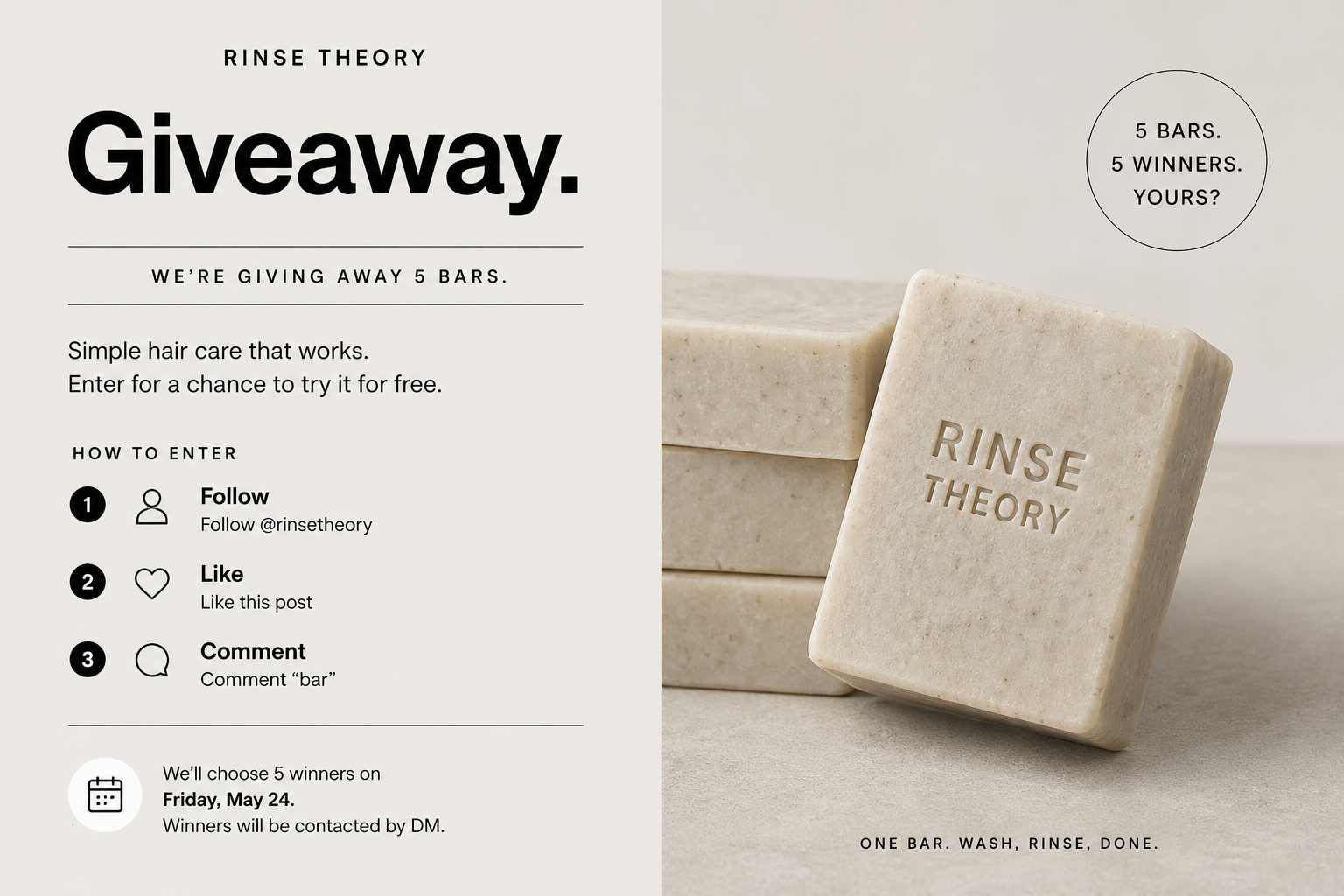
The brand's most ownable trait was already on the page: it defined itself by subtraction. "You don't need a routine." "No bottle. No buildup." "This takes them away." The thesis was hiding in plain sight. The job wasn't to invent a voice. It was to codify the one already operating beneath every line of copy — and give it the range to scale past its founder.
Rinse Theory speaks in declarative fragments. Sentences average six to eight words. Punctuation is austere, periods do most of the work. There is a recurring rhetorical move worth naming: the brand defines itself by subtraction. This is its single most ownable trait.
We delivered a full brand voice audit: a diagnostic across five live touchpoints, a codified voice framework with four attributes and three tonal registers, and an operational do/don't language guide for any writer — human or AI. The result is a system that protects the voice as the brand grows past its first writer.
Most brands have a voice. Few have a system. A Garden & Glyph audit diagnoses what's already working, names what's drifting, and delivers a framework writers and AI tools can use to scale the voice without diluting it.
Here is the audit we delivered for Rinse Theory.
Rinse Theory has a rare advantage: a brand identity so disciplined it could carry a category. The single-product proposition, the editorial restraint, the refusal to oversell — these are not happy accidents. They are a coherent worldview rendered in type, image, and language.
The audit found three things worth knowing.
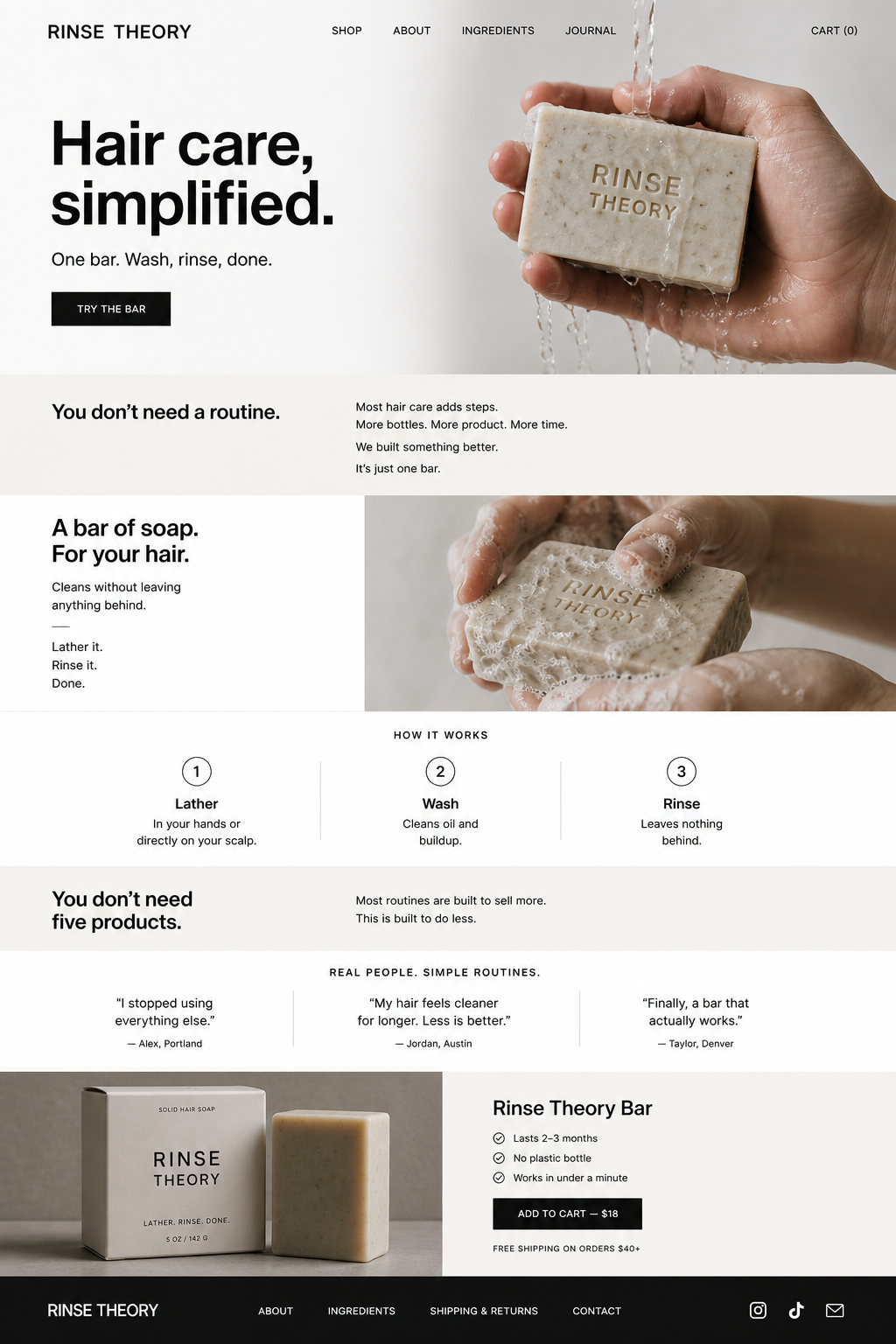
Fig. A / The surface under audit
Five live touchpoints, selected to represent the brand's full surface area — from owned platform to paid social to community-building activation.
Homepage
The flagship voice. Hero proposition, product narrative, three-step explainer, social proof, and conversion module.
Organic Social Grid
Nine-tile launch series. Pure brand-building. Tests how voice holds when stripped to single sentences and image.
Giveaway Flagship Post
Promotional activation. The hardest test of any premium brand's voice: can it stay restrained while running a contest?
Giveaway Campaign Grid
Sustained nine-day campaign. Tests voice consistency across repetition and CTA variation.
Product Packaging Copy
"Solid Hair Soap. Lather. Rinse. Done." The voice at its most compressed — and most revealing.
Rinse Theory speaks in declarative fragments. Sentences average six to eight words. Punctuation is austere — periods do most of the work. There is a recurring rhetorical move worth naming: the brand defines itself by subtraction. This is its single most ownable trait.
"Most routines are built to sell more. This is built to do less."
The thesis statement of the brand. Everything else is downstream of it.
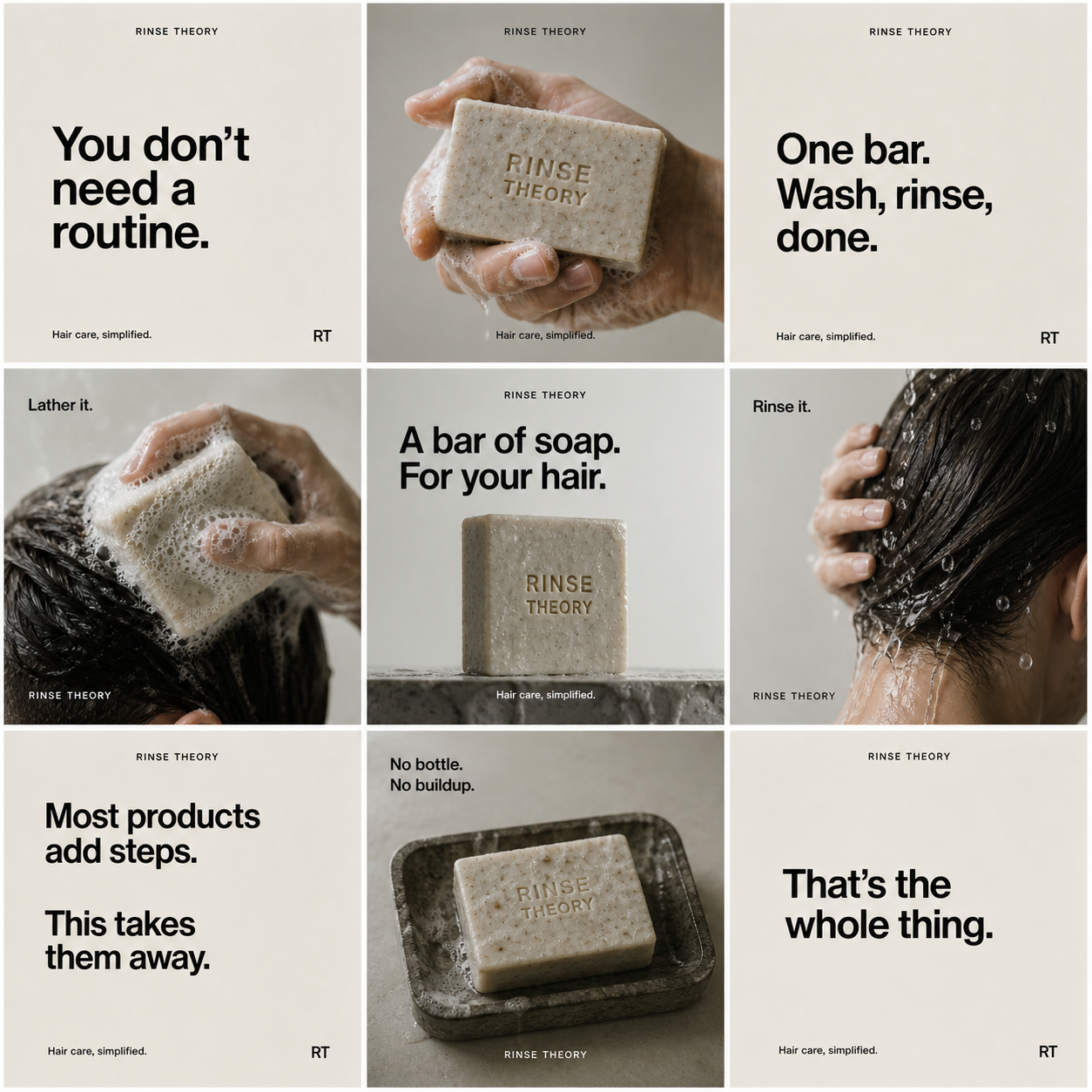
Fig. B / The voice at single-sentence scale
The framework codifies what the brand already does instinctively and gives writers and AI tools a structure to scale it.
Rinse Theory speaks like someone who has thought about this longer than you have and feels no need to prove it.
Restrained
Says the minimum required. Trusts the reader to fill in the rest.
Declarative
States, doesn't pitch. Confident enough to make claims without softening them.
Quietly Oppositional
Defines itself against the category, but never names competitors.
Editorial
Reads like a magazine, not a marketer. Treats the reader as intelligent.
The voice flexes across three registers. The attributes remain constant; only the depth and rhythm change.
The Headline
Four to eight words. Pure declaration. Hero copy, social tiles, packaging.
One bar. Wash, rinse, done.
The Explanation
Two to four short sentences. Product pages, ad captions, section intros. Allowed to develop a thought.
Most hair care adds steps. More bottles. More product. More time. We built something better. It's just one bar.
The Editorial
Paragraphs. Journal posts, founder letters, long-form education. The brand's largest growth opportunity.
The hair care aisle is a study in addition. Every year, more steps. More categories. More bottles in the shower. We didn't set out to make a simpler product. We set out to make an honest one. A bar of soap, for your hair. That's the whole thing.
Operational rules for any writer — human or AI — generating Rinse Theory copy. These are the rules that protect the voice from drift.
Rinse Theory is one of the most coherent emerging brand voices in personal care. The discipline is already there. The audit provides the framework to keep it intact as the brand grows past its founder, past its first writer, and into the hands of teams and AI tools that will inevitably be asked to produce more copy at less cost.
A voice this good deserves a system that protects it.
Disclaimer — Projects featured are conceptual case studies created to demonstrate brand voice, positioning, and creative strategy. Any resemblance to existing brands is coincidental unless otherwise stated.